

The feelings wheel
The feelings wheel: all 121 feelings, mapped
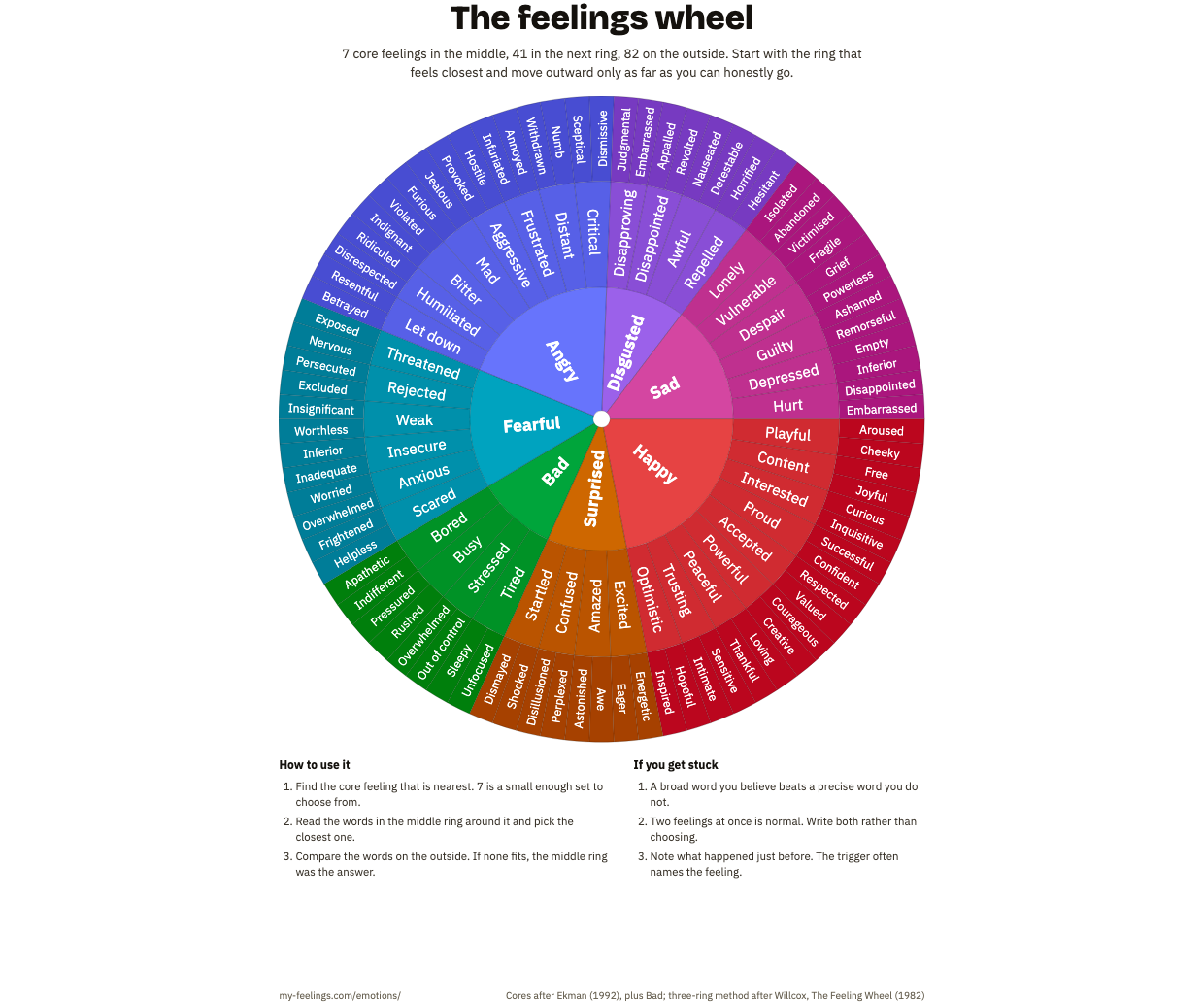
Start where you can, then move outward until the word actually fits. 7 core feelings in the middle, 39 in the second ring, 75 at the edge — one page each.
The wheel below is linked at its centre: tap one of the 7 core sectors to open it. From there the branch fans out — the middle ring holds 39 secondary feelings and the outer ring 75 more specific ones, 121 in total, each with its own page. Every label is in the list underneath the wheel, and every one of them is a link.
Six of the seven core feelings are Ekman's basic emotions (1992). The seventh, Bad, is not his — it comes from the MyFeelings app, whose vocabulary this wheel follows. The three-ring structure — core outward to more specific words — follows the method of Gloria Willcox, The Feeling Wheel (1982), whose own six cores are different words.
What a feelings wheel is
A feelings wheel is a circular diagram that groups emotion words by how closely related they are: a small set of broad feelings sits at the centre, and each one branches outward into more specific words. Instead of searching your memory for the right label, you start broad and narrow it down until a word actually matches what you noticed.
How it works
The wheel narrows from general to specific in three steps. The centre holds 7 core feelings. Each one opens into the middle ring, 39 feelings in all, and each of those opens again into the outer ring — 75 specific words at the edge. 121 in total, each with a page of its own.
How to use it
Start in the centre: pick whichever of the 7 core feelings is closest to what you noticed. Open its branch and choose the middle-ring word that narrows it, then the outer-ring word only if it adds something true. Stop as soon as a word fits — reaching the edge is never required.
For the longer version — choosing between two words that both fit, or none that do — see How to use the wheel.
Prefer a list to a diagram? The same 121 names are below, grouped the way the wheel groups them, with the specific feelings under each secondary shown as chips.
Happy
Ease and openness — things are going well enough to enjoy them. Playful, content, proud and peaceful cover a wide range, from a private win to simply having what you need.
Surprised
The gap between what you expected and what actually happened. It can tip toward delight or toward confusion, depending on which way that gap runs.
Bad
Depleted or pressed rather than pointed at anything in particular.
Fearful
Bracing for something that might go badly. Scared answers to something right in front of you; anxious, insecure and rejected all answer to something further off.
Angry
Something crossed a line that matters to you. Frustrated and mad are the sharp end of it; distant and critical are what it looks like once the heat has gone out.
Disgusted
Rejection — of a taste, an act, or a standard being broken. Disapproving and repelled point outward, at someone else's choice; awful and repugnant point at the thing itself.
Sad
Loss, or the absence of something you needed. Lonely and hurt are about what's missing right now; guilty and despair are about how you got there.
Which one is it
Some feelings sit close enough together that habit picks the wrong one. The four below share a branch of the wheel — one reaction to a clear threat, one to no threat in particular, and two ways the second kind narrows down. Match the trigger and the timing, not just the intensity, and the right word usually settles it.
| Feeling | What's usually behind it | How to spot it |
|---|---|---|
| Scared | Something in front of you right now — a sound, a diagnosis, a near-miss. | Sharp and immediate. It eases once the actual danger has passed. |
| Anxious | A sense that something could go wrong, without one clear trigger. | Runs in the background for hours or days rather than spiking and fading. |
| Worried | One specific thought you keep coming back to. | You can usually name the exact thing — a bill, a result, a phone call. |
| Overwhelmed | Several demands landing at once, with no clear place to start. | Feels less like fear of one thing and more like too many things at once. |
These four sit under Fearful; the same kind of overlap shows up in every branch, and each feeling's own page names the neighbours it gets confused with.
How the app uses the wheel
The same wheel is the check-in screen: tap a core feeling, then its secondary and specific rings, and the word is logged with a date and time. Add a note or a context tag if you want detail, or leave it at the word. The Feelings-Wheel check-in page has the rest, and the glossary defines the vocabulary around them.
The whole wheel on one page
The wheel above is the one to use on a screen. On paper it fits an A4 sheet with every label printed, which is the version to put on a wall or hand to someone who is not going to install anything.
Start with one check-in
Thirty seconds, once a day. In two weeks you have a map of what actually moves you — and it works offline.